

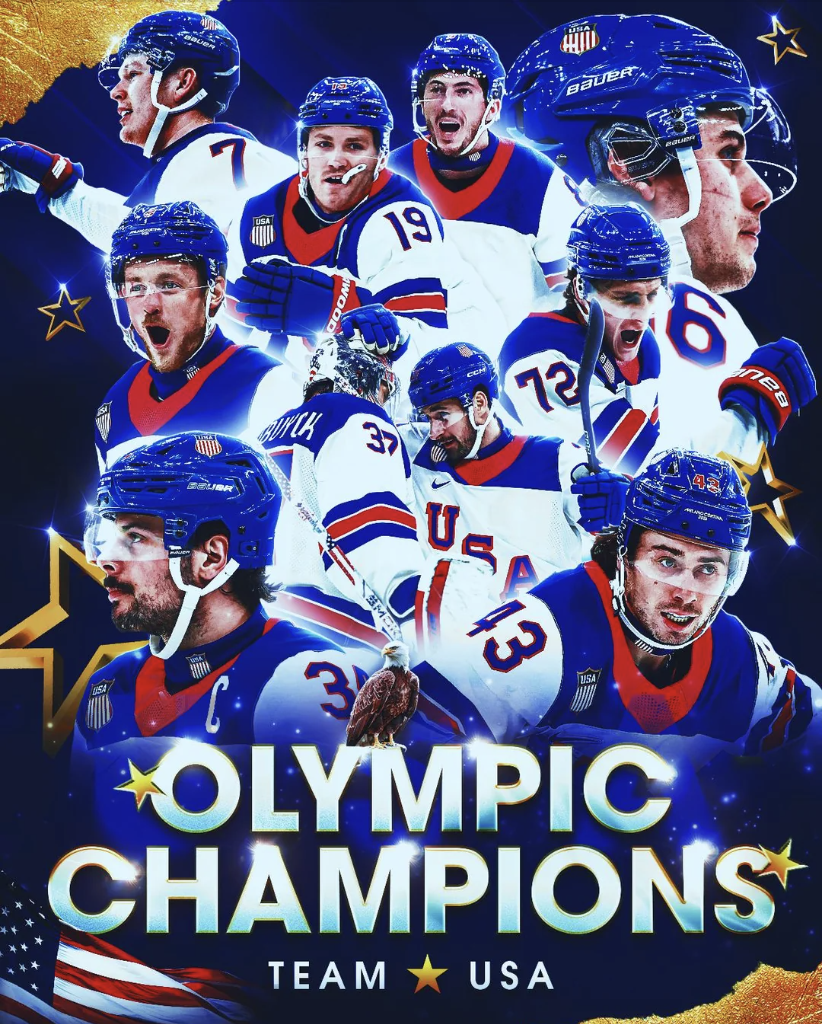
Jack Hughes may have skated off missing a tooth, but he left the ice with something much bigger: a gold medal and a permanent place in USA Hockey history. His overtime winner delivered a 2-1 victory over Canada and gave the United States its first Olympic gold in men’s hockey since the 1980 “Miracle on Ice.”
The golden moment came less than two minutes into a tense 3-on-3 overtime. Zach Werenski stripped Nathan MacKinnon of the puck, turned up ice, and fired a cross-ice pass to a wide-open Hughes. The New Jersey star buried the shot, and in an instant, gloves, sticks, and helmets were airborne as Team USA flooded the ice in celebration. (post)
Hughes’ path to the winner was as gritty as it was spectacular. In the third period, he took a high stick from Sam Bennett that chipped at least one of his front teeth and led to a four-minute power play for the U.S. Hughes joked that he first looked down and saw his teeth on the ice, while Matt Boldy said everyone would be focused on his gold medal instead.
No one feels surprised when Hughes delivers in the biggest moment. His brother, U.S. defenseman Quinn Hughes, calls him a gamer, praises his mental toughness and love for the game, and labels him an American hero. Jack speaks afterward about adversity and the shared journey everyone is on, saying every player on the ice battles through something to reach this stage and that all of them can feel proud of the game they just played.
Behind the scenes of the golden goal stood a goaltending performance that will be talked about for decades. Connor Hellebuyck stopped 41-of-42 shots, repeatedly bailing out Team USA as Canada pushed in waves and tilted the ice their way, especially in the second period.
Hellebuyck’s highlight reel from this game was remarkable. He denied Connor McDavid on a breakaway midway through the second period, then later used the paddle of his stick to rob Devon Toews on what looked like a sure tap-in into a gaping net in the third. Teammate Matthew Tkachuk said the performance belongs among the greatest of all time, alongside Jim Craig in 1980 and the best outings from any American goaltender. Dylan Larkin added that Hellebuyck should never have to pay for a drink in his home state of Michigan again.
For Hellebuyck, this gold medal game carries a personal edge. The Vezina and Hart Trophy winner arrives at the Olympics with critics still pointing to his rough 2025 Stanley Cup playoffs, when the Jets pulled him three times in the first round. After the win, he tells doubters they can keep writing if they want, insisting they do not understand his position or his game and that moments like this are the true measure of what he is building.
Team defense backed him up at every turn, especially on the penalty kill. The U.S. survived a 93-second 5-on-3 midway through the second period and finished the tournament a perfect 18-for-18 while shorthanded. That spotless record was a particular point of pride for players like Vincent Trocheck and J.T. Miller, who had heard plenty of criticism about their selection over more purely offensive names. Trocheck said he knew there were more skilled players in the NHL, but that he and Miller came to fill specific roles on the penalty kill and in the faceoff circle, and they fully embraced that job.
The result capped a “gold or bust” mindset that American players had adopted months before the tournament. They made good on that mantra by beating their biggest rival in a best-on-best setting for the first time since the 1996 World Cup of Hockey. It also completed a dream week for USA Hockey, as the women had already defeated Canada 2-1 in overtime to capture gold earlier in the Games.
Inside the U.S. room, the run felt like more than just a roster coming together. Quinn Hughes said the team regularly connected with American legends Brian Leetch and Chris Chelios before games, linking the current group to the program’s past. Larkin talked about the tight-knit mix of Boston players, Michigan natives, and the influence of the Tkachuk brothers, who helped make sure everyone felt included and respected. The chemistry was strong enough that players admitted they did not want the experience to end.
Even living arrangements played a role. While Team Canada chose to stay at a hotel, the Americans stayed in the Olympic village, something Larkin credited for strengthening their bond and giving them a real sense of the broader Olympic spirit. Head coach Mike Sullivan said he had received countless messages about early-morning watch parties back home and noted that people across the United States, including the president, were tuned in for the showdown.
Canada entered the final without captain Sidney Crosby, who suffered a lower-body injury in the quarterfinals against Czechia and ultimately could not play. Crosby said he simply was not able to go, crediting the medical staff for getting him as close as they did but acknowledging that the decision was clear once he tested himself.
The win also carried a deeply emotional tribute. As part of the celebration, Werenski, Tkachuk, and captain Auston Matthews skated with a Johnny Gaudreau jersey, honoring the late U.S. star who died in 2024 along with his brother when they were struck by an SUV while cycling. Gaudreau’s jersey hung in the American locker room all tournament, and after the medal ceremony, two of his children joined the team on the ice for a photo.
On the ice, the gold medal game itself lived up to the billing. Boldy opened the scoring six minutes in, giving the U.S. an early lead. Canada surged back in the second, outshooting the Americans and finally breaking through when Cale Makar tied it late in the period. Both sides generated dangerous chances and even missed open nets in a frantic, up-and-down contest that showed off the best players in the world.
Canada had become used to living on the edge in this tournament, erasing deficits in both their quarterfinal and semifinal wins and spending only a few minutes total playing with a lead in elimination games. This time, their comeback magic ran into Hellebuyck’s hot hand and Hughes’ finishing touch.
When Hughes’ shot hit the back of the net in overtime, defenseman Charlie McAvoy said he essentially blacked out from the emotion and could not remember who he hugged or where he went, just that it felt like pure joy. For the United States, the moment was more than just a win over their rival. It ended a 46-year wait, fulfilled a “gold or bust” promise, and opened a new chapter in American hockey, written by a chipped smile and a goaltender who refused to bend.
Appreciate you reading as always, your support is more appreciated than you know! Don’t miss our newest video on YouTube—watch it below now!