Category: CFB News

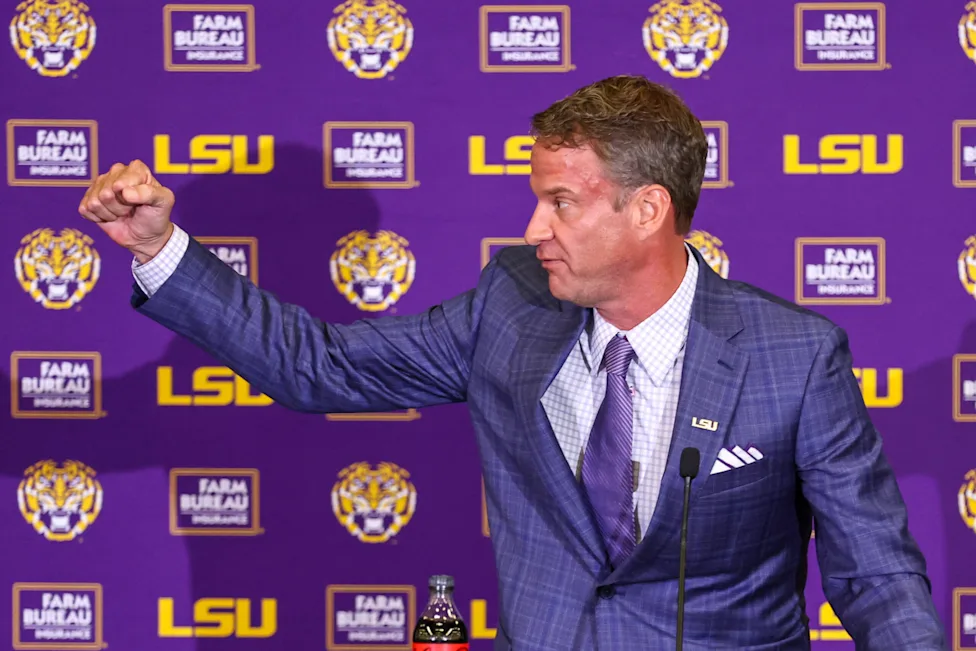
LSU football players back Kiffin on ex-NFL adds before opening season vs. Clemson

By: @OOSSports

Lane Kiffin LSU football

Lane Kiffin said Monday he was torn about chasing former NFL rookies who want a fifth college season — especially with the SEC fighting the idea. Then his own locker room settled it.

He put the situation in front of LSU’s player leadership group: tight end Dae’Quan Wright (cut by the Browns), defensive tackle Zxavian Harris, and former Tigers edge Jack Pyburn, all recently released by NFL teams. Wright has already been practicing. So has former Notre Dame defensive end Junior Tuihalamaka.

The vote wasn’t close. ESPN’s Heather Dinich first reported that Kiffin said every player on the leadership group was emphatic: if the additions can help LSU win, bring them.

“Every one of them was emphatic about, ‘If they can help us win, bring ’em,’” Kiffin said at his weekly news conference. One player framed it as how the NFL and the real world already work. That, Kiffin said, made him “feel a little better in the struggle.”

Kiffin’s final roster is due to the SEC on Friday, one day before LSU opens at home against Clemson. He said it’s too soon to say whether any of the late arrivals play Week 1.

He also said LSU wouldn’t have to cut anyone to add them. The Tigers are already under the 105-man cap, and season-ending injuries return those spots.

Texas coach Steve Sarkisian took the opposite stance the same day. He said he isn’t refreshing court rulings all day, and that bumping a player who’s been in the building nine months so a guy coming off an NFL roster can take his place “doesn’t sit well with me. I think that’s wrong. That, morally, is wrong.”

The legal fight remains open. On Thursday in Baton Rouge, a judge will hear arguments on whether the SEC and NCAA violated the court order with new penalties tied to the pro-athlete rules. The current temporary restraining order blocks the league from punishing a school that plays a football player added after he signed an NFL (or NBA/WNBA) contract.

Those penalties are not small: a half-season coach suspension, a fine equal to 50% of the sport’s annual budget, and loss of league voting rights.

If the TRO gets tossed, Kiffin said LSU will follow SEC rules. He said there has never been a plan to play someone ineligible.

“The SEC had a stance, made a rule,” he said. “A judge felt that they couldn’t do that to the players, so we’ll be practicing, focused on Clemson… they can figure out the rest and we’ll just wait for guidance.”

Kiffin’s close: he’s lived in chaos for a long time. Controlled chaos is fine if the players understand it. He said he doesn’t make these calls to protect his reputation.

“Even if it’s a couple of players that maybe don’t even start, if it makes your team better, and it’s legal to do, and the players want it, I’ll take the hit publicly for it. That’s my job.”

NCAA proposes major eligibility rule changes with new five-year window

NCAA sports story 4/8

The NCAA is considering one of the most significant rule changes in modern college athletics.

According to a report from Ross Dellenger of Yahoo, the NCAA is proposing a new eligibility structure that would dramatically alter how long student-athletes can compete at the collegiate level. (Source)

NCAA explores strict five-year eligibility window

An NCAA committee will meet next week to discuss implementing an age-based eligibility model.

Under the proposal, athletes would receive five full years of eligibility, beginning with either the player’s 19th birthday or their high school graduation, whichever comes first. The rule would eliminate redshirts, waivers, and most exceptions, creating a more rigid and standardized system.

Only limited circumstances, such as maternity leave, military service, or religious missions, would allow for exceptions.

If approved quickly, the new structure could take effect as early as the fall season.

NCAA proposal aligns with recent executive order

The proposal closely mirrors a recent executive order signed by Donald Trump, which outlined a “five-year participation window” and called for more structured transfer rules. (Source)

Dellenger reported that the NCAA had already been working on these changes prior to the executive order, though the two now align in principle.

NCAA aims to simplify current eligibility system

Current NCAA rules allow athletes to compete in four seasons over a five-year period, with opportunities to extend eligibility through redshirts and waiver requests.

That system has led to increasing legal challenges, as athletes have pursued additional eligibility through the courts. The proposed changes would eliminate those pathways and replace them with a fixed eligibility timeline.

The goal is to create a clearer and more enforceable framework that reduces ambiguity and potential litigation.

Impact on future athletes and recruiting

The proposal could significantly alter decision-making at the high school level.

Families and prospects often reclassify or delay enrollment to maximize eligibility windows. Jonathan Givony has noted that some players enter college at 20 years old, which under the new system would reduce their available eligibility.

This change could reshape recruiting strategies and player development timelines across multiple sports.

The new rules would also impact athletes currently navigating eligibility disputes.

Cases involving players such as Trinidad Chambliss, Joey Aguilar, and Chandler Morris highlight the growing tension between athletes and the NCAA over eligibility extensions.

Under the proposed system, additional years through waivers or court rulings would become far less likely.

The same applies to situations involving players attempting to return from professional stints, such as James Nnaji and Charles Bediako.

What comes next

The NCAA will review the proposal in the coming days, but approval remains uncertain.

Conference leaders and stakeholders must weigh the benefits of a simplified system against the potential impact on athletes and recruiting pipelines.

If adopted, the rule would represent a fundamental shift in how college sports operate, bringing an end to the extended eligibility era and introducing a stricter, more defined structure moving forward.


Thanks for reading. Be sure to check out the latest episode of the OutOfSightSports YouTube series below for more coverage, analysis, and the latest updates across the sports world. 🎥 ⬇️

James Franklin Fired Up for Redemption at Virginia Tech

Virginia Tech logo

James Franklin isn’t looking back—at least not for long. After a stunning fall from grace at Penn State in 2025, the veteran coach has landed at Virginia Tech with plans to turn frustration into fuel.

“I got a huge chip on my shoulder,” Franklin said to On3 Sports. “Kind of an unusual situation. Six games earlier, we’re playing for national championship. Now obviously some things happened that were in my control and I take total responsibility for that. But, yeah I got a big chip on my shoulder. Extremely motivated.”

Once a contender for the College Football Playoff crown, Penn State’s season unraveled fast. The Nittany Lions dropped three straight to fall to 3-3, a skid that ultimately cost Franklin his job. Despite leading the program to the 2024 CFP semifinal, his inability to beat elite opponents lingered—his record against top-10 teams sat at just 4-21.

Now, the 54-year-old coach is embracing his next challenge in Blacksburg. Virginia Tech hasn’t cracked 10 wins since 2012, and expectations are tempered for a program seeking renewed identity under new leadership. Franklin’s energy, however, suggests complacency won’t be an option.

“We got a lot of work to do,” Franklin said. “Most importantly, our players are driven, excited, and motivated. We got a really good core group of guys that stayed at Virginia Tech and guys that we brought from a number of other places too.”

The Hokies will kick off the 2026 campaign at home against VMI on September 5, a matchup that marks the official start of Franklin’s redemption story. For now, the message from Blacksburg is simple: the rebuild begins with belief.

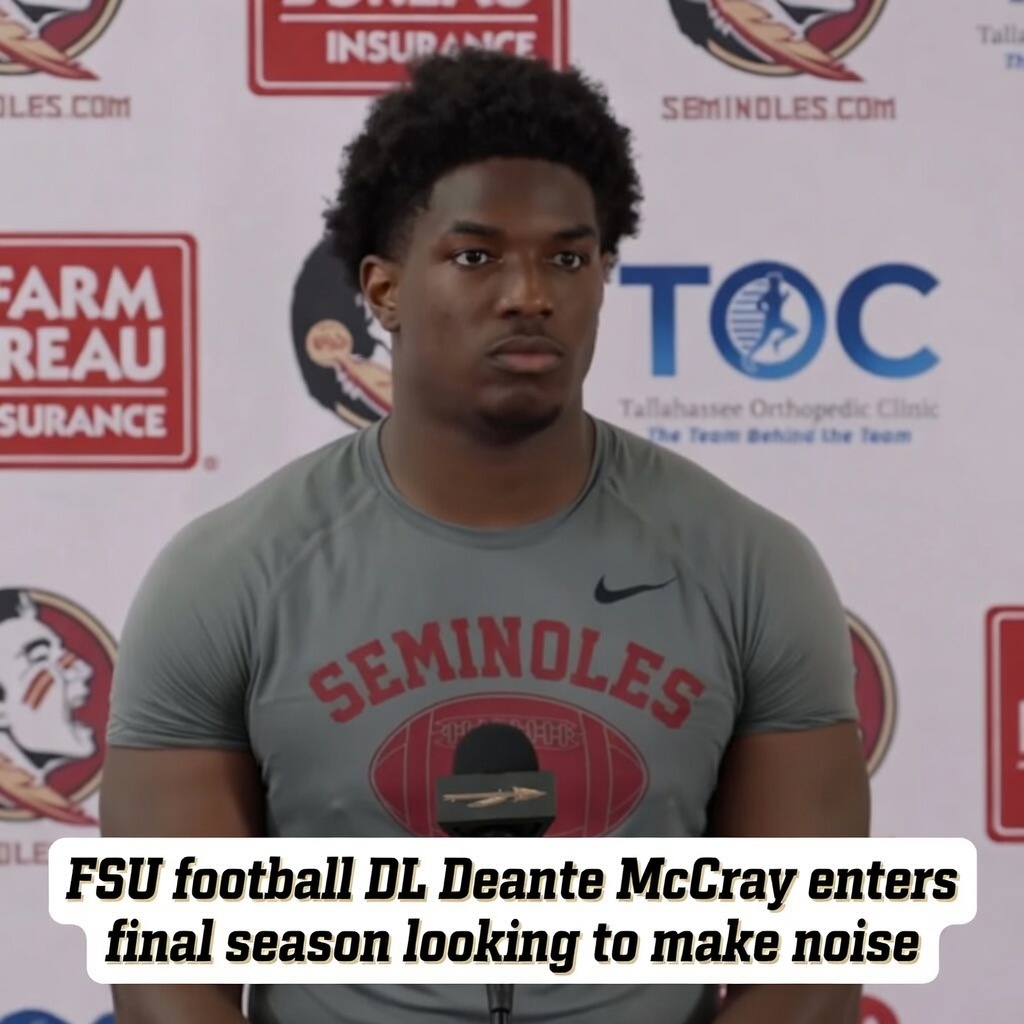
Florida State football DL enters final season looking to make noise

It’s only his second year at Florida State, but Deante McCray already carries himself like a veteran on the Seminoles’ defensive line. In many respects, he is. Despite spending just one season in Tallahassee, the former Western Kentucky transfer has three years of college football experience and has accumulated 129 career tackles, including 12 tackles for loss. No other player on Florida State’s defensive line brings that level of production.

McCray expects to elevate his performance even further in 2026.

“I learned a lot last year,” McCray said as Florida State continued its second week of spring drills, as noted in an article by On3Sports’ Corey Clark. “I learned a lot about what it actually takes to be a D-Lineman. I learned a lot from Coach [Terrance] Knighton, and how to be an aggressive D-Lineman. Just attack and be relentless. Being relentless was the biggest thing I learned. Don’t let nothing stop you in your tracks. Being a more effective pass-rusher for sure. (source)

“He helped me hone in on my run-stopping skills as well. I’m grateful for that. I plan to dominate this season. That’s what I plan to do to help this team to a championship.”

To reach that level, McCray will need to surpass last season’s production. In his first year of Power 4 football, he appeared in 12 games for the Seminoles, making two starts and finishing with 25 tackles, 4.5 tackles for loss, and one sack.

He demonstrated that he belongs at this level, serving as a consistent presence in the defensive line rotation throughout the season. This year, however, McCray aims to be more than a rotational player. He is determined to earn a starting role and believes he has the potential to become a standout.

“Now, I know the defense in and out,” McCray said. “I’m flying around. No more thinking. Just wreak havoc. Make plays. Celebrate with my teammates, catching wins and help bring this team to championships. Like I said, I’m ready to dominate. I’m more comfortable than I’ve ever been here, and I plan to showcase that this year.”

McCray has been working at multiple positions along the defensive line, embracing versatility, though he expects most of his playing time to come on the interior.

When asked about his offseason goals as he approaches his final season of college football, his focus remained straightforward.

“Just keep getting better,” McCray said. “Because I can always improve at something. Even if I’m doing something good, I can always improve at something. Get better at my run-stopping ability, my pass-rush ability. All of that.”

He will also benefit from another season under Knighton, a former NFL veteran entering his second year as Florida State’s defensive line coach.

“He’s succeeded where I’m trying to get to, which is ultimately the NFL,” McCray said. “So, I listen to everything he has to say as far as technique-wise, as far as get-offs, all of that. He’s taught me a lot. When I first transferred in, I didn’t even know half this stuff existed in terms of mindset, ways of thinking of getting to the quarterback.

“So, it’s been a blessing to have him as my coach.”


Thank you for reading the this article — make sure check out our YouTube channel and latest video below! 🚀

Texas gets major boost with Laurence Seymore ruling

Lawrence Seymore ruling

Texas avoided a major offseason setback and turned it into a roster win that could shape its 2026 outlook on Wednesday. What once appeared uncertain has now become a clear upgrade for the Longhorns.

The Seymore news became official when first reported by On3’s Pete Nakos, when the NCAA granted his eligibility waiver, clearing the way for him to play in 2026. The decision eliminates months of uncertainty and gives Texas a proven offensive lineman ready to contribute immediately. (source)

Seymore’s path to this point has been anything but straightforward. He has moved through multiple programs—including Miami, Akron, and Western Kentucky—navigating redshirts, transfers, and even a full season without game action due to transfer timing complications. That lost 2023 season ultimately became the focal point of his waiver request.

Rather than dragging the situation into a prolonged dispute, the NCAA approved the waiver, allowing Texas to move forward with clarity. The Longhorns now add a second-team All-American–caliber presence to an offensive line unit that continues to evolve through the transfer portal.

Seymore’s addition also strengthens a broader recruiting strategy built on experience and depth. He joins a transfer class that includes Jonte Newman, Dylan Sikorski, and Melvin Siani, giving the Longhorns multiple options in the trenches.

Timing plays a critical role. Securing eligibility early allows Seymore to fully integrate into offseason development and system installation rather than playing catch-up later in the year. That stability often marks the difference between depth and impact in college football.

For Texas, this move goes beyond filling a roster spot. It signals confidence in navigating complex eligibility situations while continuing to build a competitive foundation up front.

Now, with the waiver resolved, the focus shifts to performance. If Seymore delivers at the expected level, this decision could become one of the most important under-the-radar wins of the Longhorns’ offseason.

Clemson lands rising 4-star LB Bryce Kish in 2027 class

Clemson football may have landed a major building block for its future defense. Four-star linebacker Bryce Kish reportedly committed to the Tigers, according to On3 & Rivals’ Hayes Fawcett. (source)

The fast-rising 2027 prospect from Michigan has emerged as one of the most intriguing defensive athletes in his class. His commitment would represent a significant early win for Clemson’s recruiting efforts as the program continues building its next generation of defensive playmakers.

Kish stands around 6-foot-4 and weighs roughly 210–220 pounds. He pairs that length with rare straight-line speed for a linebacker. Reports indicate he has run an 11.1-second 100-meter dash and carries 4.5-range speed in the 40-yard dash. That combination makes him a unique hybrid defender capable of covering ground quickly.

The Michigan standout also plays both ways in high school, lining up as a running back and defensive playmaker. On offense, Kish is known as a physical runner who is difficult to bring down in open space. Defensively, he flashes range, length, and fluid movement skills that allow him to operate effectively in coverage or pursuit.

Recruiting services recently elevated Kish into four-star territory after a breakout stretch that boosted his national ranking. Several Power Four programs had already shown strong interest, including Michigan State, Michigan, Minnesota, Purdue, Rutgers, and Louisville.

Reports indicate Clemson extended an offer during its Elite Retreat recruiting weekend. That annual event often serves as a launching point for new priority targets across the board.

If Kish’s commitment holds, it would represent a high-upside addition to Clemson’s future linebacker pipeline. His size and speed project well in modern defensive systems that prioritize versatility and space defenders.

For Clemson, adding a long, athletic linebacker like Kish could help strengthen the defensive ceiling in future recruiting classes. His developmental upside and multi-position skill set make him the type of prospect capable of growing into a major defensive contributor once he arrives on campus.

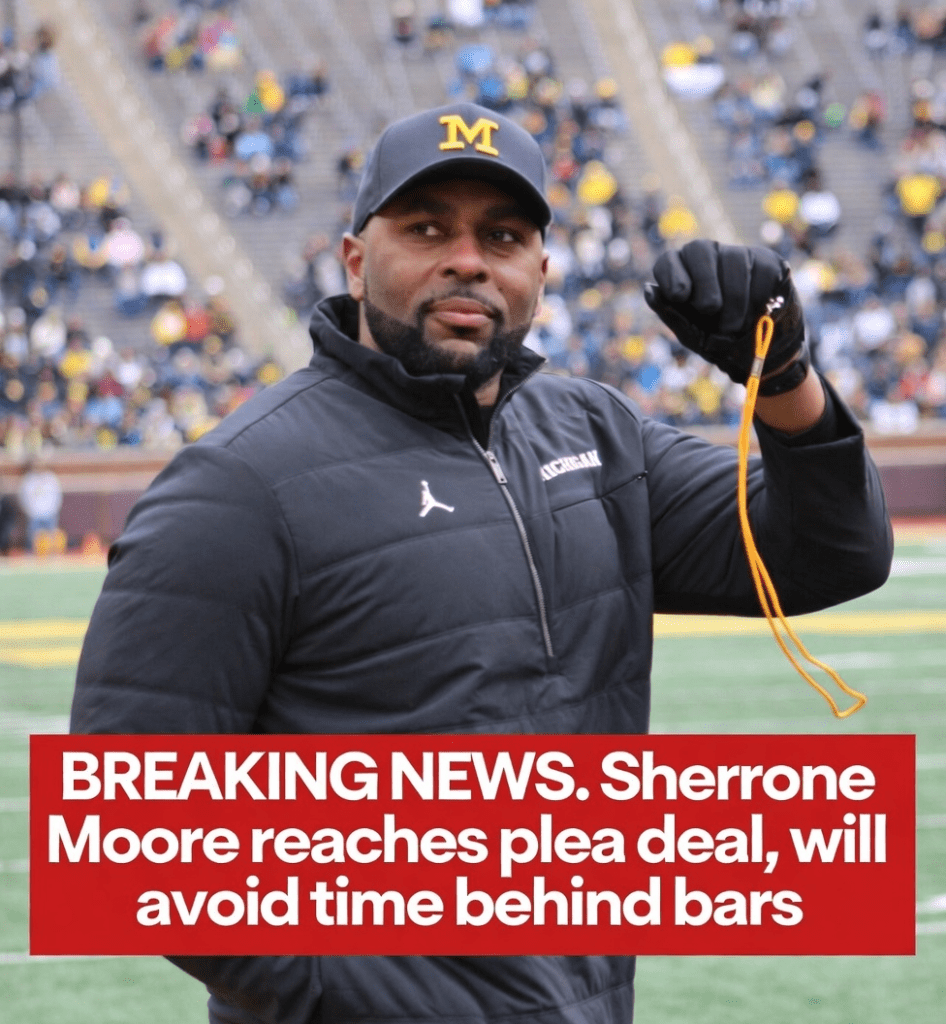
Former Michigan HC Sherrone Moore plea deal suddenly ends court case

Former Michigan football head coach Sherrone Moore will avoid a trial after reaching a plea agreement with prosecutors in a legal case that drew significant attention around the college football world.

According to a report from The Detroit Press, Moore agreed to plead no contest to malicious use of a telecommunications device and one count of trespass. Both misdemeanor charges were formally introduced Friday during a hearing before 14A District Court Judge J. Cedric Simpson. (Source)

Moore’s plea deal also led to the dismissal of three previously filed charges in the case, including a third-degree felony home invasion count.

The legal situation stems from an incident involving Moore and his former executive assistant. According to reports, the assistant previously told police that Moore entered her apartment after their two-year relationship ended. The case had been moving toward a key hearing that could have included testimony if prosecutors pursued the original charges in court.

Instead, the case shifted after additional evidence was reviewed.

First Assistant Prosecuting Attorney Kati Rezmierski addressed the court and explained why prosecutors changed their approach to the case.

“After additional evidence has been presented to us, [we] do not believe that there is sufficient evidence to prove account of domestic violence in this matter; not historically and not what happened on December 10,” Rezmierski said, referencing the date Moore went to the residence of the assistant.

That determination led prosecutors to dismiss the more serious accusations and move forward with the misdemeanor counts included in the plea agreement.

The case had the potential to turn into a lengthy courtroom battle for the former Wolverines head coach if it moved toward trial. Instead, the plea agreement brings the legal situation to a close without additional testimony or extended litigation.

With the agreement now finalized in court, the case is expected to conclude without a trial as Moore accepts the reduced charges.

Iowa State HC TJ Otzelberger on Kansas Before Saturday Rematch

The rematch between the Kansas Jayhawks and Iowa State Cyclones arrives witt different stakes than their first meeting in January.

At that time, Iowa State entered undefeated at 16-0, while the Jayhawks were unranked and searching for consistency. Since then, KU has surged to No. 9, stacking wins over multiple top-15 opponents, including a statement victory vs. No. 1 Arizona on Monday.

Thursday, Iowa State head coach TJ Otzelberger addressed the transformation he has seen from Bill Self’s squad with the media. (SOURCE)

“Their confidence certainly has grown immensely,” Otzelberger said. “I mean, at that point in time, they were still kind of trying to lock in on their identity, and you can tell they were practicing with great spirit because you could see it in the game. And they’ve been able to carry that forward to not lose a game in that stretch. So, their confidence is really high, they’ve obviously shown even when Peterson isn’t out there how well they can play and how great a team that they are.”

Otzelberger has consistently shown respect for Bill Self and the Kansas program. His comments reflect a coach who understands the magnitude of the challenge, especially against a team riding one of the strongest midseason stretches of Self’s tenure.

Kansas’ seven-game win streak has featured balanced scoring and sharper defense. Melvin Council Jr. sparked the second-half rally with 23 points and six assists against Arizona.

The biggest storyline entering the matchup centers on the status of Darryn Peterson. Otzelberger acknowledged that Kansas has proven capable regardless of his availability.

Since taking over in Ames in 2021, Otzelberger holds a 3-6 record against Kansas. All three victories have come inside Hilton Coliseum over the past three seasons, a streak the Jayhawks aim to snap.

With Kansas carrying momentum and Iowa State defending home court, the rematch presents a defining test for both programs.

Big Ten Proposal Reveals What a 24-Team College Football Playoff Would Look Like

The future of the College Football Playoff could look dramatically different from today’s 12-team structure.

According to ESPN’s Pete Thamel, the Big Ten Conference has circulated an internal document outlining a potential roadmap to a 24-team College Football Playoff. The proposal includes a phased expansion timeline, the removal of conference championship games and an increased emphasis on home-campus postseason matchups.

Nothing has been finalized, but the framework offers the clearest signal yet of how expansion might unfold.

Gradual Expansion Timeline

The document reportedly lays out a two-step approach. First, the playoff would expand from 12 to 16 teams in the 2027 and 2028 seasons. That format would feature five automatic qualifiers and 11 at-large selections.

Under the 16-team structure, the top two seeds would receive first-round byes. Opening-round games would take place on campus during the second weekend of December, with later rounds shifting to traditional bowl sites on New Year’s Eve and New Year’s Day. The national championship would remain scheduled for mid-January.

The larger leap comes no later than the 2029 season, when the playoff would expand to 24 teams. That model would remain in place through the end of the current CFP television contract in 2031.

Inside the 24-Team Format

In the proposed 24-team College Football Playoff, the 23 highest-ranked teams would qualify alongside one guaranteed spot for a Group of Six program. Unlike the 16-team version, the expanded field would not rely on automatic conference bids.

The top eight seeds would earn byes. Two full rounds of playoff games would be played on campus before the bracket transitions to bowl sites for the quarterfinals and semifinals. The championship game would again be staged in mid-January.

The proposal also suggests avoiding first-round rematches from the regular season whenever possible.

Eliminating Conference Title Games

Perhaps the most controversial component is the potential removal of conference championship games. The document reportedly characterizes those matchups as “artificial,” arguing they introduce unnecessary risk for teams already positioned to reach the playoff.

By eliminating title games, conferences would reduce the possibility of high-ranked teams being penalized by a late loss.

Broader Implications

The Big Ten’s model emphasizes increased late-season relevance. In an era shaped by the transfer portal, teams that improve significantly during the year could still secure postseason opportunities under a larger bracket.

Expansion would also dramatically increase the number of playoff contests — jumping from 11 games under the current format to 23 in a 24-team system. That increase would create additional media inventory and reshape revenue distribution across the sport.

While the Southeastern Conference has expressed openness to a 16-team field, the Big Ten’s push for 24 underscores a growing power dynamic in college football governance.

The 12-team playoff remains locked in for 2026. But if the Big Ten’s blueprint gains traction, the College Football Playoff could soon enter its most expansive — and most debated — era yet.

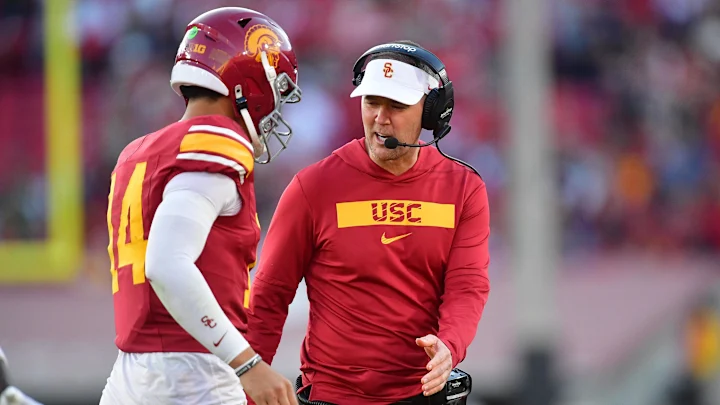
Lincoln Riley Details Jayden Maiava’s Offseason Growth Focus for 2026

USC Trojans head coach Lincoln Riley brings back his quarterback for the 2026 season. Jayden Maiava is settling in for another year in Los Angeles, his third with the program. As any QB in college football, there is going to be some room for improvement this offseason. But Riley thinks one of the biggest challenges for Maiava will be getting connected with the new USC skill position guys.

“One of Jayden’s biggest challenges this year is we’ll be very different in the wide receiver room and the tight end room,” Riley said in an interview with On3’s J.D. PicKell. “Getting in sync with those guys will be a big, big part of it.”

Impressive true freshman Tanook Hines will be the leading returning receiver for USC. Riley took NC State‘s Terrell Anderson out of the NCAA transfer portal after he put up over 600 yards in the ACC last season. And then the Trojans are bringing in some highly-skilled high school players, highlighted by Santa Ana (CA) Mater Dei tight end Mark Bowman. Fresh faces all around, outside of Hines, for Maiava to work with.

But Riley is just happy to have some stability at quarterback. He admitted having the same guy back there for three seasons is not all too common these days. Between the NFL Draft and players lacking patience, only to transfer out, Maiava has sort of become the exception.

The growth has been incredibly evident throughout the years as well, at least for Riley. Watching film from Maiava’s early days at USC and to now is apparently different. Riley says similar jumps can be made in the near future, even with all this experience.

“He grew up so much during the offseason a year ago,” Riley said. “Just watching him, the player this last year vs. what he was two years ago. It’s almost like watching two completely different people. I just feel like this guy’s got a huge ceiling. I feel like he can make another jump, just like that. He was already one of the best quarterbacks in the country this year. I’m excited for it.”

Jayden Maiava played in 13 games last season for USC, throwing for 3,711 yards, 24 touchdowns, and 10 interceptions. Riley used Maiava on the ground every once in a while, calling for 54 carries. Those went for 157 yards and six touchdowns. If Riley’s offseason expectations come to fruition, we are going to see even better numbers in 2026.